






Business account: What it is, how it works and its main benefits

Starting a company is not a simple task. Between regulatory matters, hiring employees, renting office space and developing a business...
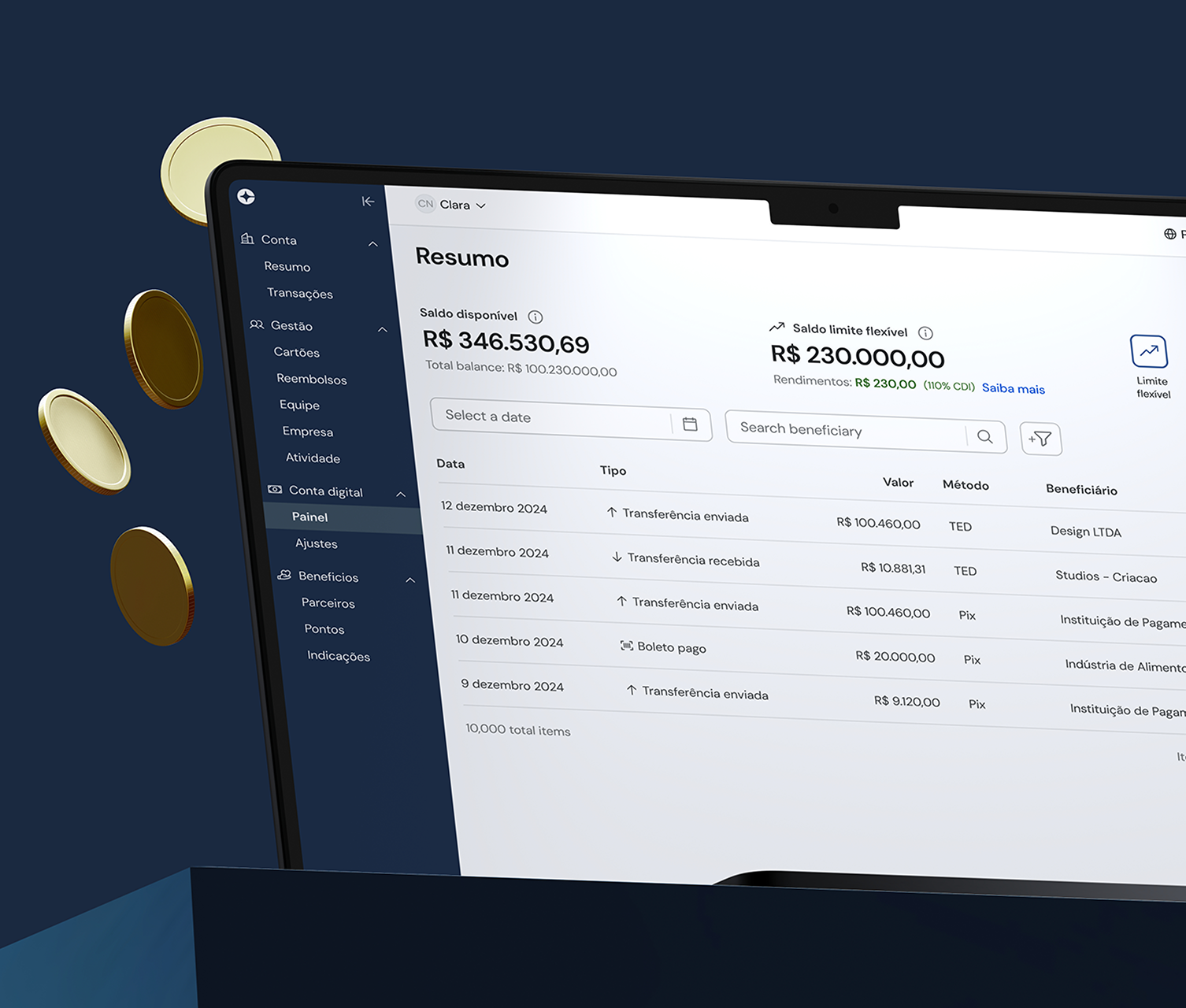
Starting a company is not a simple task. Between regulatory matters, hiring employees, renting office space and developing a business plan, there is a lot to manage.
With this heavy workload, many entrepreneurs end up making a common mistake that leads about 20% of companies in Brazil to close before reaching 1 year in business: failing to prioritize efficient financial management.
But don't worry – small changes, such as opening a business account, are already a first step toward better financial management. In this article, we'll tell you everything you need to know about business accounts so you can make an informed decision when choosing yours.
What is a business account?
So what exactly is a business account? As the name suggests, it is intended for legal entities and serves companies exclusively, regardless of their size – they may be MEI businesses, micro, small or medium-sized businesses, or large corporations. It is opened under a company's CNPJ, rather than a CPF as with bank accounts for individuals.
A business account has many of the same features as a personal account, such as Pix transfers, TED transfers and boleto payments. However, because it is designed for companies, it also comes with a range of other benefits that make day-to-day financial management easier, such as paying boletos in batches.
Does every company need a business account?
Although no law requires companies to have a business account, having an account exclusively for their own spending and receivables is a highly recommended good practice – especially for MEIs and entrepreneurs.
That's because keeping business finances organized and separate from personal finances is essential to avoid accounting confusion and ensure the business has a clear view of its financial health. In addition, many banks require a business account to grant business credit and provide other services aimed at companies.
How does a business account work?
In addition to essential banking services, there are various features and services exclusive to a business account, because companies have different needs from individuals:
- Issuing boletos: issuing payment boletos is a great way to organize your company's receivables. That way, you can set due dates and interest rates and avoid spending time collecting payments.
- Batch payments: with payments to suppliers and employees and for materials, the high volume of transactions in a company can take up a great deal of the workday. That is why a business account may offer the option to pay boletos in batches, combining several payments in a single operation.
- Issuing statements and financial reports: business accounts commonly provide detailed financial reports, enabling more detailed tracking of transactions.
- Receivables advances: one way to optimize a company's cash flow is through receivables advances, advancing amounts from sales on credit and helping maintain good financial health.
- Business credit: using business credit is a great option for those who need capital to expand, invest or maintain cash flow, helping businesses that want to grow with financial security.
What are the main benefits of a business account?
Using the business account features mentioned above brings various benefits to a company. Below, we highlight some of the main ones:
Separating personal and business finances
When a single account is used for personal and business finances, financial control becomes more difficult and can lead to confusion and errors at monthly closing. In this sense, a business account is a great ally in separating these amounts, making it easier to organize money coming into and going out of the business specifically. For MEIs and entrepreneurs, this is one of the most important benefits.
Greater control over business finances
With a business account, you can see the company's finances in real time through detailed financial reports, which make it possible to track transactions more accurately. This makes it easier to project the company's financial goals and plan investments and business expansion.
Better cash flow management
Managing cash flow well is one of the most important tasks for any finance team. A business account can help a great deal with this through products such as corporate credit cards, receivables advances and credit lines.
Connection to other systems, such as accounting
Some business accounts offer additional advantages, such as integration with ERPs and financial management platforms, making it possible to connect data in real time and automate processes such as billing and reconciliation to reduce errors and gain a more strategic view of finances.
Automated payments and receivables
Automating payments and receivables allows collections to be scheduled, makes transaction reconciliation easier and prevents delays. This helps reduce daily manual work and gives the business greater predictability.
Makes it easier for the company to comply with tax requirements
A business account makes tax compliance easier because it centralizes income and expenses. This simplifies accounting, speeds up the issuance of invoices and brings greater organization to fulfilling tax obligations.
How do you open a business account?
Opening a business account is becoming increasingly simple, especially at fintechs, where the opening process is usually handled online, quickly and securely. Below is a guide to opening your business account:
1. Choose a financial institution
Analyze all the business account options available on the market and compare fees, services and features to find the one that best fits your needs.
2. Gather the required documents.
Have the documents on hand to speed up the process. The documents generally required include:
- The company's active CNPJ.
- Identification documents for the partners.
- Proof of the company's address.
- Articles of Association or formalized MEI registration.
Depending on the account and bank chosen, other information and documents may be necessary.
3. Register online
Fill in your details on the chosen financial institution's website or app. Then simply wait for the account to be approved and start using it once everything is ready.
Digital business account vs. traditional bank: Which is better?
To choose the ideal business account for your company, you first need to know the options available on the market.
Alongside traditional banks, there are fintechs such as Clara that specialize in the business market and offer accounts that are 100% digital, with less red tape and lower costs than traditional banks.
Digital accounts offer advantages such as:
Feature
Digital Business Account
Traditional Bank
Opening
Online and fast
May require an in-person visit to a branch
Fees
Lower or waived
Higher and varied
Customer service
100% digital
In person and digital
Credit limit
Flexible; can be increased based on money kept in the account
Harder to change; depends on internal reviews
Issuing and blocking credit cards
Online and fast
Online or by phone and email, depending on the bank
How to choose the best business account for your company
Your company's finances are no joke, and choosing the ideal business account for your business is an important step toward efficient, professional financial management. That's why it is important to consider:
- Fees and charges: Some accounts have no fees, while others charge for withdrawals, transfers and issuing boletos. Pay attention and analyze them carefully.
- Features offered: As we discussed above, some services offered by business accounts can make companies' daily work much easier. Favor those with greater flexibility and variety.
- Customer support: Favor financial institutions that offer fast, effective support so you can avoid difficulty resolving any problem.
As we've seen, having a well-structured business account can make all the difference to your company's financial health and growth. Besides separating personal and business finances, simplifying management and financial visibility, it brings various benefits, such as better cash flow management, tax compliance and automation of slow manual processes.
Clara's digital business account
The Clara digital account is offered exclusively to companies and has various benefits for optimizing financial management. Besides offering free, unlimited Pix transfers and boleto issuance, it provides returns of up to 110% of net CDI. Want to learn more about Clara's digital account? Fill out the form.