

August 4, 2026
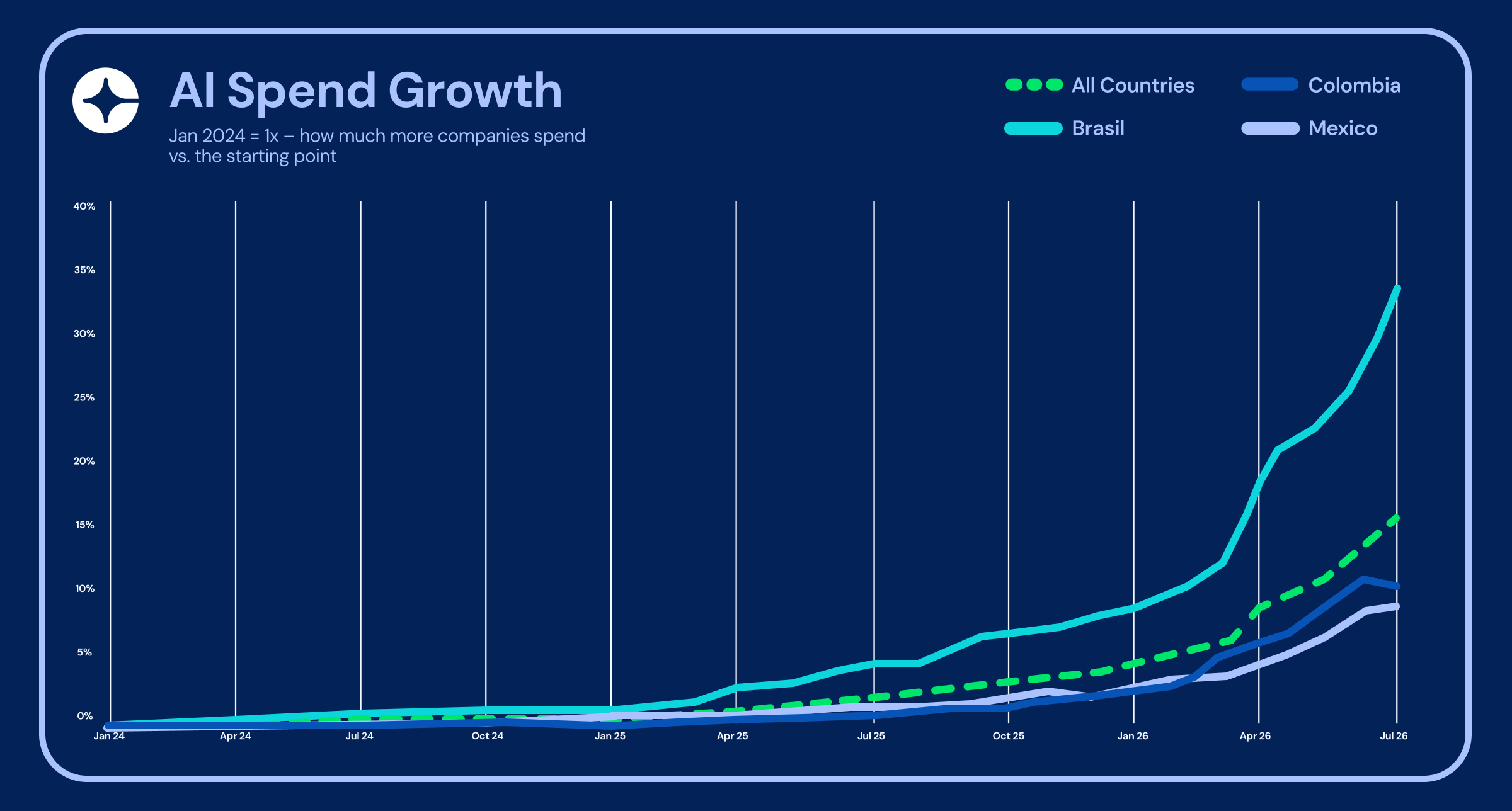
Enterprise spending on artificial intelligence is growing six times faster than adoption in Latin America. Between January and July 2026 alone, expenditure tracked by Clara grew 2.8 times higher, while adoption rose from 24.6% to 33.4% of active companies.
This difference shows that market expansion no longer depends primarily on the arrival of new buyers. A large portion of the shift happens after a company starts paying.
Brazil showed the most intense acceleration in 2026. In seven months, spending grew 3.8 times higher. In Colombia, it multiplied by 3.2. In Mexico, by 2.3. In all three countries, adoption advanced, but without matching the speed of disbursements.
There are several possible explanations, and they may be occurring simultaneously.
The first is model consumption. When a company uses APIs, the bill follows processing volume. More calls, more tokens, and more applications in production drive up spending without changing the adoption rate. For tracking purposes, the company remains a single adopter. For the finance department, it turns into a much more expensive client.
The second is seat expansion. A tool might enter through a small team and later spread to other departments. The company isn't recounted as a new adopter every time it adds users, but the vendor takes up a larger share of its budget.
The third is the multiplication of the AI stack. The same company might pay for language models, programming tools, productivity platforms, and voice services. Each additional vendor increases expenses, even though the adoption rate remains unchanged.
There is also a composition effect. As companies move from simple tools to usage-based products or solutions embedded in more intensive processes, average spending can rise even without a major shift in the number of buyers.
For finance departments, this dynamic makes the adoption rate an insufficient metric. Knowing how many teams use AI doesn't reveal how much expenses might grow in the following months. A company can keep the same number of tools while increasing consumption. It can maintain the same number of adopting teams while purchasing more licenses. Or it can add vendors without any of this appearing in traditional penetration indicators.
Tracking needs to separate the initial onboarding of a tool from its subsequent expansion. This requires monitoring spending per vendor, seat counts, API usage, monthly variation, and concentration by team. Without this visibility, an apparently stable budget can be caught off guard by the intensity of use.
The growth in 2026 suggests that AI is ceasing to be just a purchasing decision. It is becoming an expense that scales within the company after approval. For finance teams, it is this second phase—faster and less visible—that now matters most.


.webp)






.png)